SATS is a leading provider of aviation food services, preparing meals for airlines, premium lounges, and institutional customers like schools, hospitals, and military camps around the world.
In Singapore, SATS prepares over 120,000 meals each day for airline passengers, restaurants, and other customers. Outside Singapore, SATS runs catering facilities and food businesses in Asia and Europe, including India, Thailand, China, Japan, the Maldives, and the UK.
These operations rely on dedicated chefs and cooks who blend creativity with operational excellence to deliver quality at scale. Making meals takes more than cooking skills. It also requires strict food safety, careful planning, large-scale production, and smooth teamwork to make sure every meal reaches customers safely and on time.
These same qualities shone at the 2025 Food Hospitality China (FHC) International Culinary Arts Competition, where Team SATS won two gold and three silver medals.
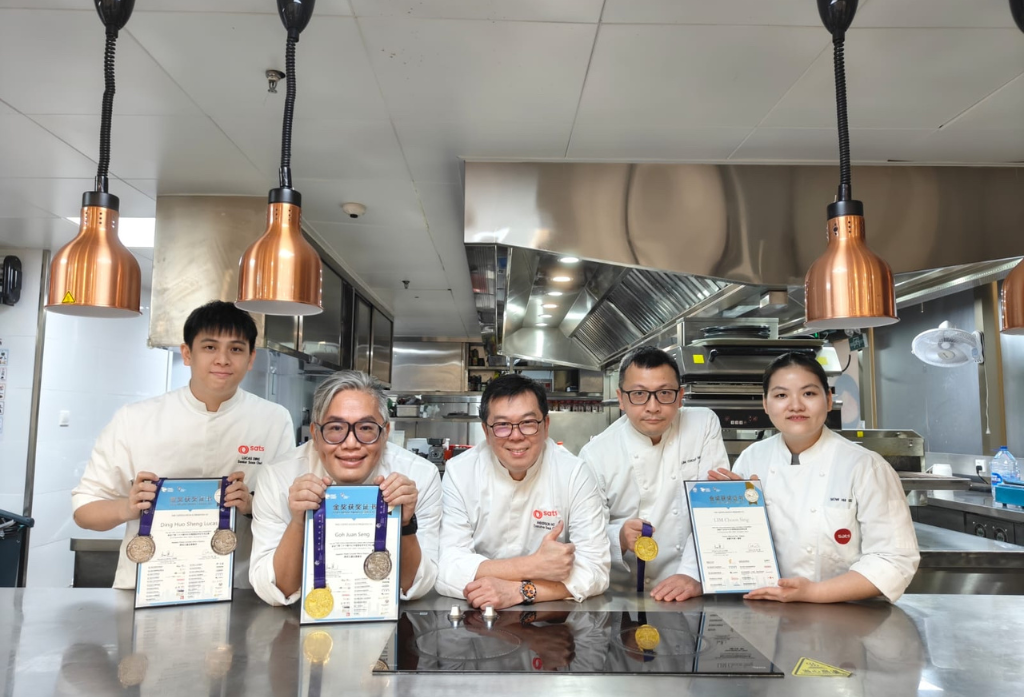
[L to R] Lucas Ding Huo Sheng, Johnson Goh, Anderson Ho, Lim Choon Sing, Siow Hui Sze with their medals from FHC Shanghai 2025
The FHC Shanghai International Culinary Arts Competition, held from 12-14 November 2025, is one of Asia’s top culinary events. Chefs from across the region come to test their skills and creativity. It brings together Chinese and Western cuisines, sparking new ideas, encouraging teamwork, and helping develop the next generation of chefs.
The event features many categories, such as culinary arts display, Western and Chinese hot cooking, and pastry and bakery competitions. Entries are judged by strict World Chefs Federation rules, so chefs are assessed on taste, technique, organisation, hygiene, creativity, and presentation.

Team SATS at FHC Shanghai 2025
The competing chefs are part of SATS' food solutions and inflight catering operations in Singapore. When not competing, they support large-scale meal production, training, and culinary innovation at the SATS kitchens.
Anderson Ho, Executive Sous Chef for Catering Training, brought together chefs with different strengths, competition experience, and the determination to handle the tough preparation:
Lim Choon Sing, Sous Chef, Pastry Kitchen 2
Gold - Theme Afternoon Tea Display
Siow Hui Sze, Chef De Partie, Pastry Kitchen 2
Assistant to SC Choon Sing
Johnson Goh, Executive Sous Chef, Culinary Design & Development
Silver - Western Hot Cooking (Salmon)
Gold - Culinary Arts Display (Western Three-Course Menu)
Lucas Ding Huo Sheng, Senior Sous Chef, Integrated Regional Support Group
Silver - Western Hot Cooking (Lamb)
Silver - Culinary Arts Display (Western Three-Course Menu)
Darren Chin Siong Wei, Executive Sous Chef, Integrated Regional Support Group
Assistant to ESC Johnson and SSC Lucas

A Culinary Arts (Cold) Display entry by Team SATS
One of the most misunderstood categories in culinary competitions is the cold display (culinary arts display). Contrary to popular belief, it is far from easy.
In this category, dishes are fully cooked and prepared ahead of time, then displayed cold for judging. Judges focus on knife skills, structure, symmetry, hygiene, creativity, and overall execution. Visual perfection matters most.
"Cold display is like building edible architecture,” Darren, who has joined the same competitions before, explains.
Read also: Team SATS wins gold at the 14th Salon Culinaire
“It is overnight work,” Johnson shares. Gelatin had to be cooked, set, layered, and assembled with absolute precision. "Every component needs time and focus.”
Strict temperature control and craftsmanship are both essential. Unlike hot cooking, there is no 60-minute time limit. Instead, the work starts long before competition day and continues until every chef finishes a three-course cold menu with an appetiser, main dish, and dessert.
“We’re grateful for the SATS network,” Johnson adds. “Our colleagues at SATS China opened their kitchen doors so we could do our preparations.”
With strong teamwork and support from the SATS community, the team won both gold and silver in the culinary arts display competition. Johnson and Lucas led the effort, with Darren supporting them.

A Western Hot Cooking (Lamb) entry by Team SATS
While cold display requires patience, hot cooking is all about speed and control. Johnson and Lucas also competed in the Western hot cooking categories, with Johnson preparing salmon trout and Lucas preparing lamb. Each chef had 60 minutes to make a main course using the assigned protein, creating two identical plates for the judges.
Everything had to be prepared on the spot. Judges closely watched timing, organisation, flavour balance, and cleanliness.
Both chefs earned silver medals, even though they worked with unfamiliar ingredients. “Products in Chinese supermarkets, like the vegetables, differ from what we are used to in Singapore,” Lucas explains. “We had to adjust our recipes quickly without compromising standards.”

Team SATS’ award-winning entry for the Theme Afternoon Tea Display
Choon Sing has represented SATS in competitions before. In his daily work, he supports large-scale inflight catering and helps oversee pastry production for commercial flights. Making these pastries means keeping them consistent across thousands of servings, while meeting strict food safety, quality, and airline requirements.
At FHC Shanghai, he and Hui Sze competed in the Theme Afternoon Tea Display category. They had to create six different desserts, with seven identical pieces of each, all presented in a buffet-style display within 60 minutes and under constant observation. “Judges and spectators are right there watching you,” Choon Sing says. “You have to stay calm and focused.”
In the end, Choon Sing won a gold medal, scoring 95 out of 100, the highest score in any category at the competition.
Many people think professional kitchens are just about cooking, but making meals at scale needs a wider range of skills.
Chefs in aviation, hospitality, and institutional catering have to balance creativity with food safety, large-scale planning, quality checks, and efficiency. Whether they are making meals for airline passengers, lounges, hospitals, schools, or other customers, teams must keep meals consistent across hundreds or thousands of servings while meeting strict quality and hygiene standards.
Success takes more than just cooking skills. Organisation, teamwork, adaptability, attention to detail, and working well under pressure are just as important to make sure meals are delivered safely, consistently, and on time.
Preparation started months before the competition, with all the chefs balancing busy work schedules and training. They had failed attempts, reworked recipes, and made many improvements along the way.
“We kept refining the dishes and presenting them to our Executive Chef, Kim Wah,” Hui Sze shares. “We failed many times but learnt each time.”

The chefs had to stay back after work and train for their respective competition categories
Lucas and Johnson trained every week, and Lucas and Darren often traveled across Singapore after work just to practice. During the competition, Johnson went without sleep for 63 hours. He laughs about it now, saying, “I never knew I could still do that at my age.”

Chefs Lucas and Darren are trying a recipe for the cold display competition
FHC Shanghai was Lucas's first culinary competition and his first time representing SATS on an international stage.
“Honestly, I wasn’t interested at first,” he admits. “But Darren encouraged me, and eventually I wanted to give it a try.”
How was the experience? “Tiring,” he says with a smile. “It reminded me of my restaurant days. But I learnt a lot, and overall, it was a great experience.”
With guidance from fellow chefs Darren, Johnson, and Anderson, Lucas earned two silver medals in his very first competition.

Team SATS had a fun time in Shanghai after the competition
The team’s achievements at FHC Shanghai show the depth of SATS’ culinary skills and the values our people bring to the kitchen every day: creativity, competence, consistency, and high standards in food safety and hygiene.
This mix of craftsmanship and discipline is one reason SATS chefs do so well in international culinary competitions.
For Choon Sing, winning motivates him to keep quality standards high. Johnson hopes their win inspires others. “I encourage young chefs to step up. Competitions like this push you beyond your comfort zone... and your sleep,” he says, laughing.
A big congratulations to our chefs on their well-deserved win!
Q: How extensive is SATS' Food Solutions network?
SATS' Food Solutions network spans multiple markets across Asia and Europe, serving airlines, airport lounges, hospitality partners, and institutional customers. In Singapore alone, SATS prepares more than 120,000 airline meals daily. Its catering facilities and food businesses are also in India, Thailand, China, Japan, the Maldives, and the United Kingdom, supporting customers through a combination of culinary expertise, food safety standards, and large-scale production capabilities.
Q: What is large-scale food production?
Large-scale food production involves preparing and delivering large volumes of meals while maintaining consistent taste, quality, hygiene, and food safety standards across every serving.
Q: What skills do chefs need beyond cooking?
Professional chefs require a combination of culinary expertise, food safety knowledge, planning, teamwork, time management, and attention to detail. In large-scale food operations, consistency and quality are just as important as creativity.
Q: Why do chefs participate in culinary competitions?
Culinary competitions allow chefs to benchmark their skills against industry peers, learn new techniques and challenge themselves in areas such as creativity, presentation, organisation, and hygiene.