Every day, SATS Group moves cargo along trade routes that account for more than 50% of global air freight. Our network links airlines, freight forwarders and logistics providers across Asia, Europe, the Middle East, Africa and the Americas.
Whether it is e-commerce, pharmaceuticals or time-sensitive shipments, SATS plays a vital role in keeping global supply chains running smoothly.

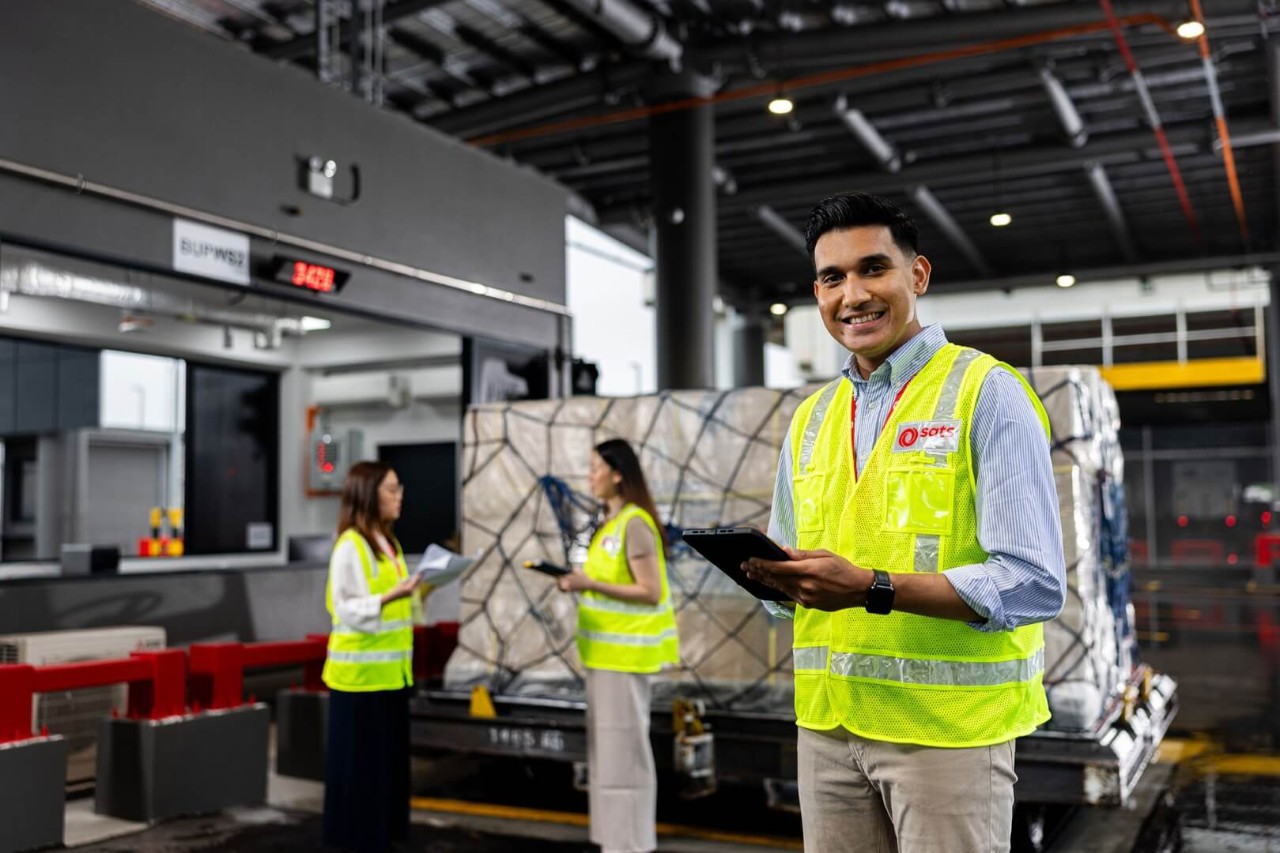
SATS operates approximately 950,000 sqm of warehouse space globally, including facilities at 14 of the world’s top 30 cargo airports
Customers pay a premium to move cargo by air, expecting it to reach its destination quicker, rather than waiting for pickup in a warehouse. While SATS focuses on cargo terminal operations, we recognise that the real challenge lies beyond preparing cargo for delivery. Equally important is how quickly and reliably it reaches its next stop.
This challenge led SATS to explore an innovative approach: using autonomous vehicles for cargo delivery. With Autonomous Cargo Vehicles (ACVs), cargo can be moved almost immediately after processing from the airfreight terminal to freight forwarders' warehouses within the Changi Airfreight Centre.
Helping drive this initiative is Priscilla Quak, Senior Manager, New Product Development (NPD), whose 13-year career at SATS has spanned multiple business functions. In her current role, she develops and scales innovative solutions across SATS' global network, including autonomous cargo delivery for Singapore operations.

Priscilla Quak, Senior Manager, New Product Development
When Priscilla Quak joined SATS in 2013 through the Graduate Assimilation Programme, she had the opportunity to experience different parts of the business early in her career. Since then, she has taken on several portfolios spanning network marketing, ground handling marketing, travel retail, integration management office and, most recently, new product development.
These experiences have given her a broad perspective on how SATS supports its customers, from airlines to cargo operators and logistics partners.
After SATS acquired WFS, Priscilla joined the integration management office to support activities across the expanded network. She was selected to participate in the Elevate programme, spending three months in the United States to learn about specialised services and spot opportunities that could be adapted and scaled across SATS.

Priscilla during her three-month assignment in the US office
These experiences have proved invaluable in her current role, where she develops new products and scales innovative solutions across SATS' global network. While her portfolio spans multiple markets and service offerings, cargo delivery using autonomous solutions is one of the initiatives she has helped develop in Singapore.
"We look at solutions that are beyond our core business and think about how we can create value for customers in new ways," she says. "A lot of it starts with understanding the challenges customers face and asking whether there's a better way to solve them."
The project began with a familiar operational challenge.
Once import cargo is processed and ready at a SATS terminal, freight forwarders must arrange for their own trucks or service providers to collect and move it to their warehouses. This creates dependencies on the availability of trucks, operators, dock slots and collection schedules.
While conventional collection may suffice for some shipments, e-commerce and other time-sensitive shipments require faster, more predictable cargo availability. Freight forwarders often face tight processing and delivery cut-offs, where every hour saved speeds up delivery to customers.
"We were looking at a problem our customers are facing," says Priscilla. "For e-commerce shipments especially, they're working towards very tight timelines. A few hours can make a meaningful difference."
Faced with this challenge, the team asked whether SATS could move cargo directly to freight forwarders instead of waiting for collection.
This led to an autonomous cargo delivery solution that combines automation, autonomous vehicles and operational innovation to solve a practical business problem.
Read also: How is SATS shaping the future of time-critical air cargo logistics

What began as an idea to solve a customer challenge is now being tested through live cargo movements within Changi Airfreight Centre
Autonomous Cargo Delivery is a service SATS developed in collaboration with technology partners. It uses autonomous vehicles to move import cargo directly from airfreight terminals to freight forwarders' warehouses within the Changi Airfreight Centre.
Instead of relying solely on conventional trucks, cargo can now be delivered directly to participating freight forwarders using autonomous vehicles. This extends SATS' role beyond terminal handling into the first mile of cargo movement.
Each autonomous cargo vehicle automates routine point-to-point cargo movements between SATS' airfreight terminals and freight forwarders' warehouses. Larger-capacity vehicles could potentially support future expansion as the service scales.
Although the concept sounds simple, developing a solution that works safely in a live cargo environment took extensive coordination, testing and refinement.
As project manager, Priscilla led the cross-functional effort, bringing together operational teams, technology partners and key stakeholders to turn the concept into a workable solution.
One of the biggest challenges was meeting the operational and safety requirements before live trials could begin, including compliance with the autonomous vehicles’ framework. The team worked closely with Changi Airport Group to secure the necessary approvals and confirm the vehicle could operate safely alongside existing cargo traffic within the Changi Airfreight Centre.
The work extended far beyond the vehicle itself. The team reviewed and refined security checks, loading and unloading procedures, cargo release processes, system integration and customer receiving processes before testing the concept in a live environment.
"A vehicle travelling from Point A to Point B doesn't automatically mean the entire operation works," says Priscilla. "The end-to-end process has to work as well."
After a successful12-week endurance run, the initiative is moving into its next phase of operational validation. The team at SATS SG Hub Cargo now leads operationalisation and commercial readiness, with continued support from NPD.
"What's exciting about this project is how different teams and partners have brought their expertise together, from developing the initial concept to making it work in a live cargo environment," Priscilla shares. "It's very much a collective effort, and that collaboration is what makes innovation possible."

Capable of carrying up to 800kg of cargo, the autonomous cargo vehicle automates routine point-to-point cargo movements
For Priscilla, the project's most important message isn't the vehicle itself.
"SATS is rethinking how cargo moves beyond the terminal," she explains. "Instead of the traditional model where cargo is handled and then waits for collection, we're exploring whether there are better ways to move cargo more directly and efficiently."
Freight forwarders could receive their cargo several hours earlier than with traditional collection, without the added complexity of coordinating their own trucking.
This project forms part of a wider shift in cargo automation, where technology is improving visibility, efficiency and cargo movement across supply chains.
"Autonomous technology is being applied to solve a real operational problem," Priscilla says. "The objective is faster and more predictable cargo movement, reduced reliance on conventional collection trucking and a smoother flow of cargo through the cargo ecosystem."
Cargo delivery using autonomous solutions marks a major step in SATS' efforts to rethink how cargo moves beyond the terminal.
With the initial endurance programme complete, the initiative is moving to the next validation stage, and partners are discussing commercial readiness and opportunities for wider deployment.
For Priscilla, the experience reinforces the importance of collaboration in turning ideas into practical solutions.
"Innovation doesn't happen in isolation. It takes different teams bringing their expertise together, challenging conventional ways of working and finding solutions that create real value for our customers," she says.
Initiatives like this show how SATS can apply new technologies beyond the terminal, combining operational expertise and collaboration to improve how cargo moves across the wider logistics chain.
Q: Can autonomous vehicles reduce delivery times?
Yes. Autonomous cargo vehicles can shorten the time between cargo availability at an airfreight terminal and receipt at a freight forwarder's warehouse, helping cargo move through the supply chain more quickly.
Q: How does cargo automation benefit freight forwarders?
Beyond speeding up cargo movement, cargo automation can improve shipment visibility, reduce manual coordination, and make collection and delivery more predictable, helping freight forwarders plan resources more efficiently.
Q: Why is SATS exploring cargo automation and autonomous cargo vehicles?
SATS is exploring autonomous technologies as part of its efforts to develop innovative, scalable cargo solutions. Its Autonomous Cargo Delivery initiative in Singapore is evaluating how direct terminal-to-warehouse delivery can improve cargo movement and customer experience.