For Nitesh, growth has never come from staying in one place.
Across a career that has taken him from India to China, the United States, Europe, and now Singapore, one constant has guided his decisions: the drive to explore new environments, take on new missions, and build solutions along the way.
It is a mindset that has consistently pushed him beyond his comfort zone into new industries, new disciplines, and increasingly complex problems. Today, he brings that same mindset in his role as the Global Head of New Product Development at SATS, where his work sits at the intersection of ground services, air cargo handling, and innovation.
His first mission: how can urgent cargo move faster, more reliably, and with greater visibility through the air cargo logistics network?
![[People] - Nitesh-Bhargava](/media/careers-our-people/time-critical-air-cargo-logistics-ft-nitesh/_jcr_content/root/responsivegrid/container/container_1453597496/image_1802166982.coreimg.png/1785140895293/nitesh-bhargava.png "[People] - Nitesh-Bhargava")
Nitesh Bhargava, VP, Global Head of New Product Development, SATS Group
Behind every shipment is something that depends on it: a grounded plane waiting for a replacement part, a manufacturing line depending on a critical component, or a time-sensitive pharmaceutical delivery racing against the clock.
“When you look beyond the cargo itself, you start to see the impact it has on the businesses and people relying on it,” says Nitesh. “That’s what makes this space so interesting and meaningful.”
![[People] - Freight-Forwarding-Services](/media/careers-our-people/time-critical-air-cargo-logistics-ft-nitesh/_jcr_content/root/responsivegrid/container/container_1453597496/image_1189099917.coreimg.png/1785140986141/freight-forwarding-services.png "[People] - Freight-Forwarding-Services")
At the intersection of airside and landside operations, SATS teams ensure cargo flows smoothly from aircraft to warehouse and vice versa
At its simplest, air cargo logistics is about moving goods across global networks using aircraft. It’s how shipments move quickly through the supply chain.
But the journey involves far more than the flight itself. It requires coordination across airport handling, customs processes, transportation networks, and final delivery to ensure shipments arrive safely, reliably, and on time.
Most shipments follow standard cargo handling processes, which are designed to move large volumes efficiently through structured workflows across terminals.
Then there’s express cargo, a premium service for shipments that need to move within tighter timelines. Express logistics prioritises speed through faster transfers to and from airlines, as well as expedited processing at air freight terminals.
But there’s another category that demands even greater urgency: time-critical cargo.
These shipments include aircraft parts needed to return grounded planes to service, pharmaceutical or temperature-sensitive goods needed for life-saving situations, and components needed to keep production lines running.
In these scenarios, delays can quickly become costly. A shipment arriving hours late can leave critical assets idle, disrupt operations, delay production, or affect time-sensitive deliveries further down the supply chain.
“The key insight,” Nitesh explains, “is that the value of time isn’t determined by the shipment alone. It depends on what that shipment enables and the situation surrounding it. Once you recognise that, you start designing cargo logistics very differently.”
For Nitesh, the opportunity at SATS is not just about moving cargo efficiently. That capability already exists at scale.
The SATS Group operates across 225 locations in 27 countries worldwide, covering trade routes responsible for more than 50% of global air cargo volumes. Across Singapore and other key cargo hubs, SATS and its subsidiary Worldwide Flight Services (WFS) have a unique advantage: they operate at the point where cargo first enters and exits the air transport network.
![[People] - Cargo-Handling-Solutions-SATS-Group](/media/careers-our-people/time-critical-air-cargo-logistics-ft-nitesh/_jcr_content/root/responsivegrid/container/container_1453597496/image.coreimg.png/1785141113234/cargo-handling-solutions-sats-group.png "[People] - Cargo-Handling-Solutions-SATS-Group")
SATS sees the full cargo journey, handling shipments from arrival to onward movement
“SATS sits in a unique position within global aviation and logistics’” Nitesh explains. “Few companies have the same combination of network scale, operational expertise, access to infrastructure, and trusted customer relationships.”
The challenge, therefore, is not moving cargo but creating differentiated services that customers, like freight forwarders and airlines, genuinely value.
For Nitesh, that means designing services that achieve three things at the same time:
Solve a real and specific customer problem
Humbly challenge operational constraints on the ground
Deliver measurable commercial value
It sounds straightforward, but innovation in cargo logistics rarely is. Cargo terminals are highly complex environments involving multiple stakeholders, strict timelines, and continuous coordination between airside and landside operations.
“If a solution cannot work on the ground, it does not matter how compelling it looks on paper,” he says.
This practical mindset helped shape the development of SATS’ Time-Critical Solutions.
![[People] - Cargo-Warehouse-SATS-Group](/media/careers-our-people/time-critical-air-cargo-logistics-ft-nitesh/_jcr_content/root/responsivegrid/container/container_1453597496/image_937486231.coreimg.png/1785141267648/cargo-warehouse-sats-group.png "[People] - Cargo-Warehouse-SATS-Group")
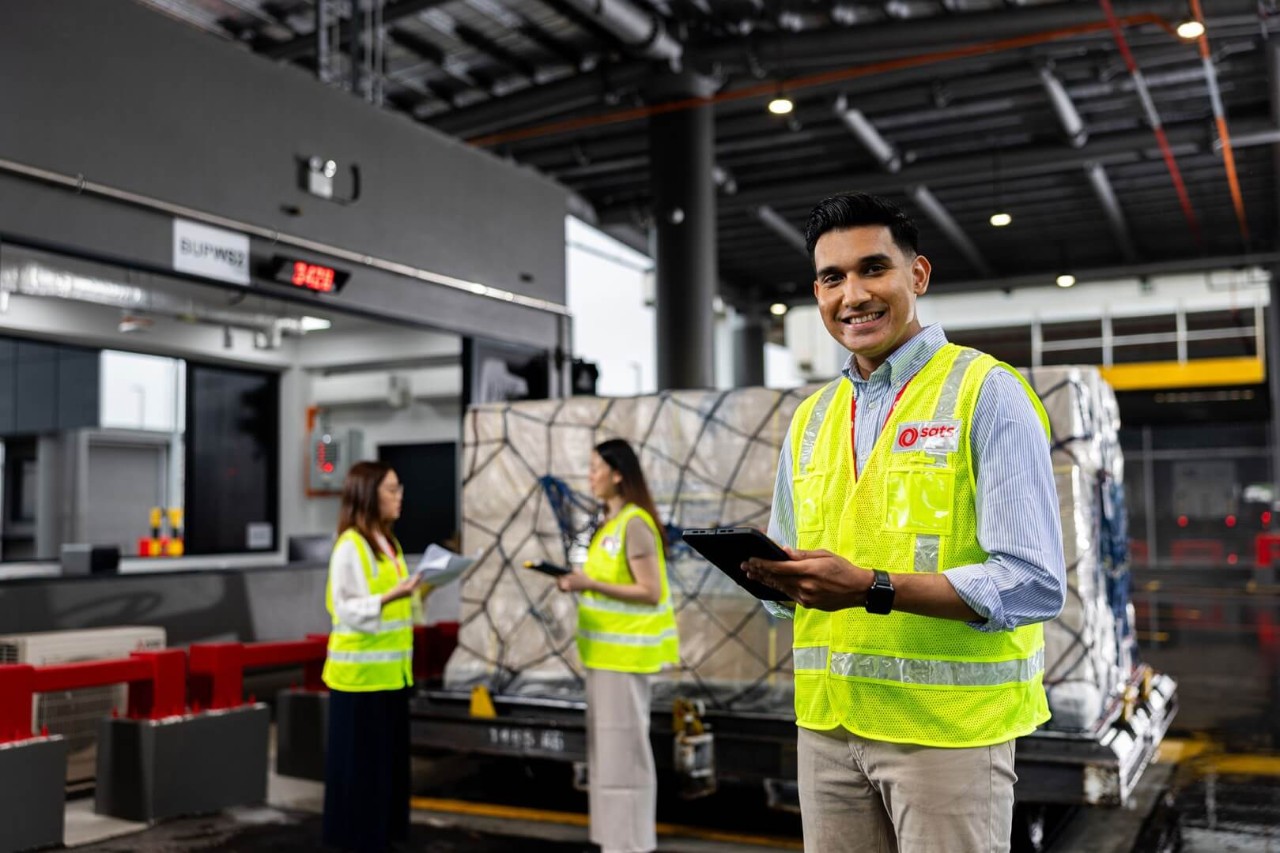
Advanced cargo capabilities at SATS are powered by our experienced people on the ground
SATS’ Time-Critical Solutions (TCS) were created to address a growing challenge in global logistics.
“At its core, TCS solves a mismatch between the urgency of certain shipments and the standard handling processes designed for general cargo,” says Nitesh.
Rather than creating an entirely separate system, TCS introduces a controlled, accelerated pathway within existing cargo handling operations.
Together, these capabilities create what Nitesh describes as an express cargo handling experience within a standard air cargo environment.
![[People] - AOG-Parts-Service-SATS](/media/careers-our-people/time-critical-air-cargo-logistics-ft-nitesh/_jcr_content/root/responsivegrid/container/container_1453597496/image_1044611400.coreimg.png/1785141483143/aog-parts-service-sats.png "[People] - AOG-Parts-Service-SATS")
SATS provides specialised handling for mission-critical parts and equipment
In global logistics, much of the journey is already optimised.
Flights are scheduled tightly, and air transport moves cargo across long distances in relatively short timeframes. But once cargo lands, the ground handling phase remains one of the few areas where meaningful time can still be recovered.
This is where TCS makes a significant difference.
By prioritising time-sensitive shipments, SATS can reduce dwell time, or the period cargo spends waiting on the ground between arrival and its next stage of movement.
For many shipments, a few hours may not matter. But for urgent cargo, those same hours can have significant consequences.
“A few hours saved in cargo handling can translate into much larger gains further down the supply chain, often in ways that are not obvious when you look only at the cargo,” says Nitesh.
Those gains might mean getting an aircraft back into service sooner, avoiding a production shutdown, or ensuring critical pharmaceutical products remain within required timelines.
“A delay rarely stays in one place," Nitesh points out. "It doesn’t stop at the cargo terminal. It spreads across the supply chain.”
Speed alone does not solve the problem in time-critical logistics.
In many cases, the bigger challenge is uncertainty. “When customers lack visibility, they are forced to plan conservatively,” Nitesh explains. “They build buffers, hold inventory, or delay decisions simply because they don’t have enough information.”
This is why visibility is a core pillar of TCS. Through digital tools, customers can track cargo milestones in real time, anticipate delays early, and coordinate downstream operations more effectively.
“The moment you give customers visibility, you change how they operate. You empower them to plan ahead, manage uncertainty, and make better decisions further down the value chain,” he adds.
Today, that combination of speed and visibility defines reliability in express logistics and air cargo services.
As global supply chains evolve, the role of time-critical air cargo and express logistics continues to grow.
Companies are operating with leaner inventories. Production timelines are tighter. Customer expectations around speed, transparency, and predictability are higher than ever.
At the same time, digital technologies are changing how logistics is experienced – raising expectations around visibility, control, and coordination.
For Nitesh, the future of cargo logistics lies in bringing these elements together: faster cargo handling processes, integrated, end-to-end coordination, real-time visibility, and data-driven decision-making.
“The shift is from speed alone to confidence,” he says. “Customers want to know that their cargo will not only move quickly, but that they can rely on it.”
And for Nitesh, that is ultimately what innovation in logistics is about – not simply moving cargo faster but helping customers operate with greater certainty in a world where delays can be costly.
Q: What is air cargo logistics?
Air cargo logistics refers to the planning, handling, and movement of goods through air transport networks. It involves multiple stages, including cargo handling, storage, documentation, transportation, and coordination between airports, airlines, cargo terminals, and logistics providers.
Q: What is time-critical cargo?
Time-critical cargo refers to shipments that must move within strict timelines and have little tolerance for delays. Examples include aircraft parts needed for grounded aircraft, temperature-sensitive pharmaceutical shipments, and manufacturing components required to keep production lines running.
Q: What are SATS' Time-Critical Solutions (TCS)?
SATS' Time-Critical Solutions (TCS) are specialised services designed to accelerate the handling of urgent shipments. TCS combines priority cargo handling, coordinated airside and landside operations, and real-time shipment visibility to help customers move critical cargo faster and more reliably.
Q: How does cargo handling affect supply chain performance?
Cargo handling plays a critical role in determining how quickly cargo moves through an airport. Efficient cargo handling can reduce dwell time, minimise delays, and improve the speed and reliability of downstream logistics operations, particularly for time-sensitive shipments.
Q: What is an AOG shipment?
AOG (Aircraft on Ground) refers to a situation where an aircraft cannot operate because it requires a critical part, component, or technical support. An AOG shipment typically involves the urgent movement of aircraft parts to minimise downtime and help the aircraft return to service as quickly as possible.
Q: How does air cargo ground handling affect delivery speed?
Air cargo ground handling plays a significant role in how quickly cargo moves through an airport. Processes such as cargo acceptance, storage, documentation, security screening, transportation between warehouse and aircraft, and shipment release all influence transit times.
Q: What happens when aircraft part is urgently needed?
When an aircraft part is urgently needed, specialised logistics processes are activated to prioritise the shipment. This may involve expedited documentation, priority cargo handling, close coordination with airlines and ground operations teams, and enhanced shipment tracking. The goal is to move the component through the airport and supply chain as quickly as possible so maintenance teams can return the aircraft to service without unnecessary delay.